
Anhui Jwell Precision Mold Co., Ltd.
Anhui Jwell Precision Mold Co., Ltd.
I. Under the background of a green and low-carbon economy, PP (polypropylene) hollow building formwork, as a typical product "replacing wood and steel with plastic," has its core component—the die head—playing a "critical throat" role in transforming design blueprints into eco-friendly finished products. Its important functions and value are mainly reflected in the following aspects:
Today, as a green and low-carbon economy sweeps the globe, the construction industry, as a major carbon emitter, is urgently seeking alternative materials that can meet construction requirements while significantly reducing environmental burden. The emergence of PP hollow building formwork precisely answers this contemporary challenge. Made of polypropylene as the base material and manufactured through an extrusion process to form a hollow structure, it successfully achieves "replacing wood and steel with plastic," demonstrating irreplaceable green value in three aspects: resource conservation, energy emission reduction, and circular utilization.
First, the most direct contribution of PP hollow formwork is saving forest resources and reducing emissions from steel smelting. Behind every square meter of traditional wooden formwork is the consumption of several kilograms of wood and the felling of thousands of trees. Although steel formwork has a high turnover rate, steel production is an industry with high energy consumption and high carbon emissions. In contrast, PP hollow formwork, while using petroleum-based plastic as raw material, has far lower raw material consumption per unit area than wood and steel. More importantly, a high-quality PP hollow formwork can be reused 30 to 50 times or more, far exceeding the 3 to 5 times of ordinary wooden formwork on the market. This means that over the entire building lifecycle, a single PP formwork can replace dozens of wooden formworks, fundamentally reducing the plundering of natural resources.
Second, in the production and usage stages, PP hollow formwork demonstrates significant energy savings and construction convenience. Due to its low density and light weight from the hollow structure, the weight of PP formwork per same area is only about one-quarter that of steel formwork, greatly reducing transportation energy consumption and on-site handling labor intensity. At the same time, the smooth surface of PP formwork has low adhesion to concrete, usually allowing easy demolding without applying a release agent. This not only saves the cost of release agents but also avoids the emission of VOCs from chemical release agents, which harm the environment and worker health, truly achieving green construction.
Furthermore, PP hollow formwork perfectly aligns with the circular economy concept. Polypropylene itself is a recyclable and renewable thermoplastic. After reaching its service life, the formwork can be crushed, pelletized, and re-extruded to make new formwork or other plastic products, achieving a closed-loop cycle of "from plastic to building material and back to plastic." Even with a small amount of impurities, it can be used as filler for other extruded products, generating almost no construction waste. In comparison, discarded wooden formwork is often only incinerated or landfilled, while discarded steel formwork requires high-energy remelting. From the perspective of full lifecycle carbon footprint, the carbon emissions per square meter of PP hollow formwork are only about 60% of wooden formwork and less than one-third of steel formwork.
Finally, as green building evaluation standards become increasingly stringent, the use of recyclable, low-energy building materials has become a key plus point for construction projects to obtain green certification. With its comprehensive advantages of light weight, high strength, high turnover rate, recyclability, and environmentally friendly construction, PP hollow formwork is rapidly replacing traditional formwork and becoming standard on green, low-carbon construction sites. It not only helps construction companies reduce overall costs but also provides a practical material solution at the macro level to promote the decarbonization transformation of the construction industry. It can be said that on the road to carbon neutrality, although PP hollow formwork is small, it plays an indispensable role as a green engine.
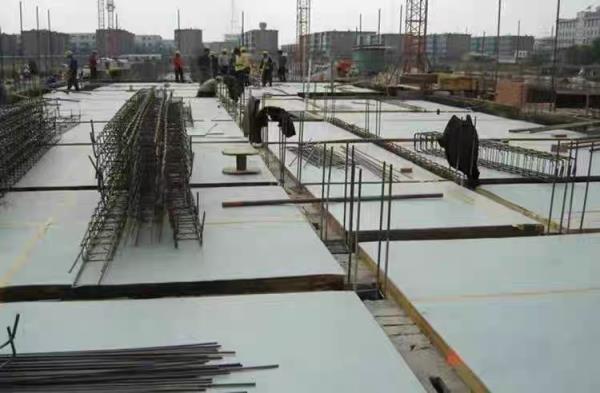
II. Core of Quality: The precision of Anhui JWELL Precision Mould's die head directly determines the mechanical properties and surface quality of the formwork.
To withstand concrete lateral pressure, impact, and repeated assembly and disassembly on construction sites, the flexural strength, flat compression strength, and surface flatness of PP hollow building formwork are key indicators, and most of these indicators are imparted by the die head.
Wall Thickness Uniformity and Hollow Structure Formation: The internal flow channels of the die head must not only distribute the melt for the top and bottom layers but also precisely guide the melt into the hollow ribs. Improper die head design can lead to problems such as "rib shifting" and "uneven bottom wall thickness," causing local stress concentration in the formwork, which can easily crack or deform during construction. A high-quality die head, through layered co-extrusion or multi-channel structures, ensures that the melt flow velocity and pressure for each hollow vertical rib are the same, resulting in uniform overall stress distribution and improving impact resistance by more than 30%.
Surface Finish and Demolding Performance: The surface of the building formwork directly determines the quality of the concrete wall after forming. The flow channels of the die head are mirror-polished to Ra ≤ 0.02μm, producing extruded sheets with a smooth, streak-free surface that meets fair-faced concrete requirements without secondary film coating. At the same time, the smooth surface reduces concrete adhesion, allowing demolding without applying a release agent, which saves costs and reduces environmental pollution from chemical release agents, making it an important plus point for green construction.
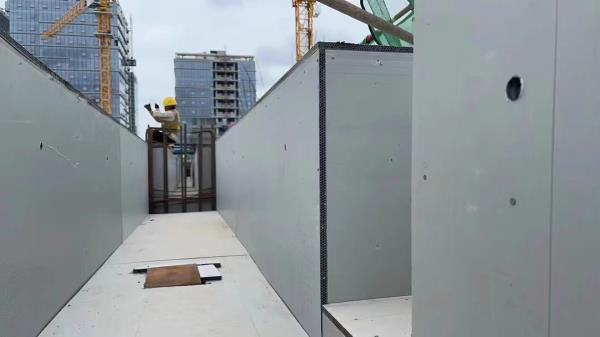
III. Efficiency and Yield: The stability of Anhui JWELL Precision Mould's die head is the economic lifeline of large-scale production.
In the continuous production of PP hollow formwork, the die head is the link with the "highest pressure resistance and most temperature sensitivity" in the production line. Once problems such as uneven material output, carbon buildup on the die lip, or thermal expansion failure of bolts occur in the die head, a large number of defective sheets will be produced.
Wide-width Production and Thermal Expansion Control: Currently, mainstream formwork widths reach 1.2 to 2.0 meters, and the die head undergoes thermal expansion at high temperatures. High-quality die heads adopt symmetrical heating and expansion compensation designs to ensure uniform die lip opening across the entire width, thereby increasing the yield rate from 85% to over 97%. For a production line with an annual output of one million square meters, every 1% reduction in scrap rate means saving dozens of tons of plastic and corresponding energy and labor costs.
Quick Changeover and Customization Capability: Construction sites require formwork of different thicknesses (12mm, 15mm, 18mm, etc.) and different hole patterns. High-performance die heads equipped with micro-adjustable die lips and quick-connection flanges allow specification changes to be completed within 30 minutes, and start-up adjustment waste is reduced from the conventional 200 kilograms to less than 50 kilograms. This provides the technical possibility for die head rental companies or large formwork manufacturers to achieve "multiple specifications, small batches, and just-in-time delivery," greatly enhancing market responsiveness.
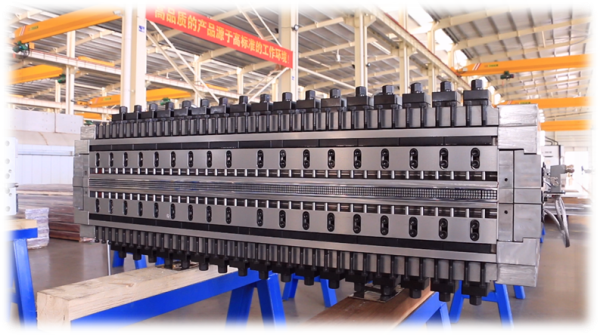
IV. Summary of Application Advantages: From Tool to Platform
In summary, Anhui JWELL Precision Mould's die head for PP hollow building formwork is no longer a single extrusion component but a technology platform integrating "rheological design, thermodynamic control, surface engineering, and quick changeover." For PP formwork manufacturers, choosing the right die head means obtaining all of the following simultaneously:
Lower raw material and energy costs;
Higher yield rate and Overall Equipment Effectiveness (OEE);
Better product mechanical properties and construction reputation;
Shorter delivery cycles and customization capabilities.
Driven by the green and low-carbon economy, the technological iteration of die heads is pushing the entire building formwork industry to transform from "high material consumption and high emissions" to "high precision, long life, and recyclability." It can be said that without the support of high-performance die heads from Anhui JWELL Precision Mould, PP hollow formwork would struggle to truly replace wooden and steel formwork, let alone gain an advantage in carbon footprint certification and green building material evaluation systems. Investing in an excellent die head is laying the most solid "green foundation" for your PP hollow formwork business.

Wechat account

